
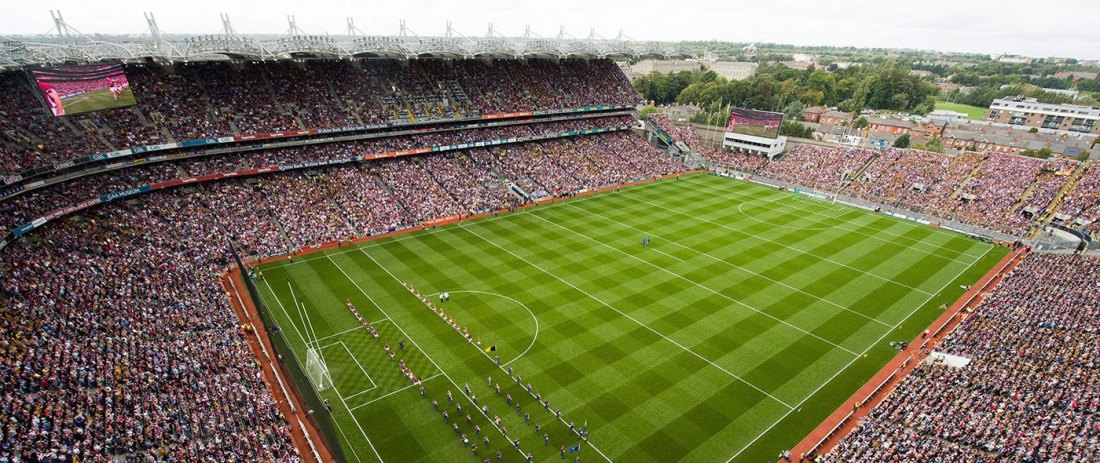
Croke Park Stadium is the biggest in Ireland and the 3rd biggest in Europe, with a capacity on nearly 83000 people. Croke Park is a three-tier stadium with 7 levels. The total area cover by Croke Park is 16 acres. The total area covered by the roof is 5 acres.
The area was used since 1870 as a sports ground. It was called Jones’s Road Sportsground. Since the foundation of the Gaelic Athletic Association, it was used for major events in Gaelic sports. In 1913 the ground was bought by them. At this time the ground had one stand and earth walls around the field. In the 1920s the capacity raised by building new stands. In the 1980s the GAA decided to build a high capacity stadium. The final constructions were in 2003.
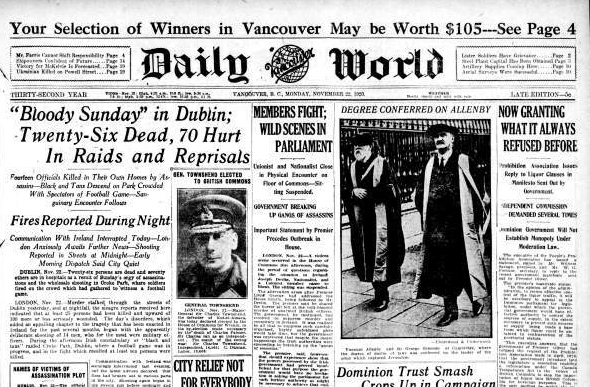
On 21 November 1920, during the Irish War of Independence. In total, thirty-two people were killed, including thirteen British soldiers and police, sixteen Irish civilians, and three Irish republican prisoners. This total includes people who were wounded but died later. Royal Marines officer Hugh Montgomery was shot in the morning and died on 10 December, and three people who were wounded at Croke Park died later – Robinson and Carroll on 23 November and Tom Hogan on 26 November.
The day began with an Irish Republican Army (IRA) operation, organised by Michael Collins, to assassinate the ‘Cairo Gang’ – a team of undercover British intelligence agents working and living in Dublin. IRA members went to a number of addresses and shot dead fourteen people (in addition, Montgomery was mortally wounded and died on 10 December): nine British Army officers (including Montgomery), a Royal Irish Constabulary (RIC) officer, two members of the Auxiliary Division, two civilians, and one man (Leonard Wilde) whose exact status is uncertain.[1]
Later that afternoon, members of the Auxiliary Division and RIC opened fire on the crowd at a Gaelic football match in Croke Park, killing eleven civilians and wounding at least sixty, three of whom died later (Robinson and Carroll on 23 November and Tom Hogan on 26 November).[2] That evening, three IRA suspects being held in Dublin Castle were beaten and killed by their captors, who claimed they were trying to escape.
Overall Bloody Sunday was considered a victory for the IRA, as Collins’s operation severely damaged British intelligence, while the later reprisals did no real damage to the guerrillas but increased support for the IRA at home and abroad.
 Marcos Travel blog