
There are 4 key elements in the Irish Constitution:
- The President

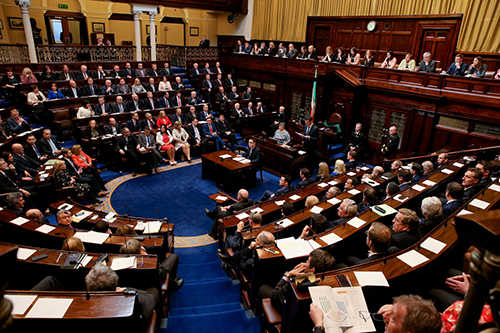
- The Oireachtas (Parliament)
- The Government

- The Courts

The Irish Constitution establishes and describes the main institutions of the State. The power to run the State is divided into 3 separate powers: the legislative power, the executive power, and the judicial power.
The legislative power is the power to make laws, that is, to introduce, remove or change legislation. Articles 15 to 27 of the Constitution give this power to the national parliament or the Oireachtas. The Oireachtas consists of Dáil Éireann, Seanad Éireann and the President.
The executive power is the power to carry the laws into effect, that is, to execute or carry out the laws with the assistance of a police force, a military force and the civil service. Article 28 of the Constitution gives this power to the Government, that is, the Taoiseach, the Tanaiste and the cabinet of Ministers.
The judicial power is the power to interpret and apply the law to disputes and conflicts that arise between the State and the individual and disputes and conflicts that arise between individuals. Articles 34 to 37 of the Constitution give this power to the courts.
 Marcos Travel blog